

Case Study
Helping GOLFZON track brand growth and sharpen its U.S. market strategy

Gobal golf simulator technology company GOLFZON was expanding to the U.S. and wanted to understand how American golfers perceived its brand, how it compared with competitors Trackman and Full Swing, and whether its marketing was building lasting awareness.
Bixa began with a comprehensive benchmarking study, then developed a quarterly brand tracker to measure progress. The ongoing research gives GOLFZON a clearer view of its competitive position, the experiences that set it apart, and the audiences offering the strongest opportunities for growth.
The challenge
GOLFZON needed a reliable way to understand its place in the U.S. golf simulator market. Leadership wanted clear quantitative findings that could guide marketing decisions and show whether changes in awareness persisted beyond individual campaigns, events, or product launches.
The research focused on:
Establishing a baseline for awareness, familiarity, perceptions, and competitive position
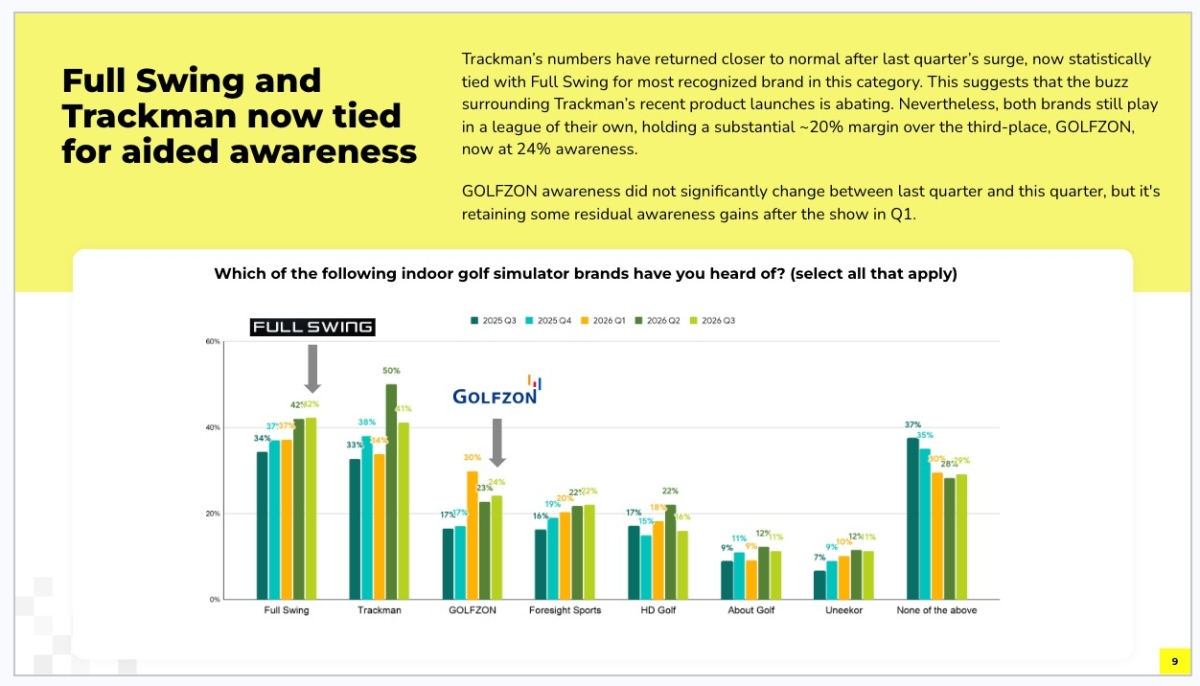
Measuring quarterly changes in GOLFZON’s brand health and competitor momentum
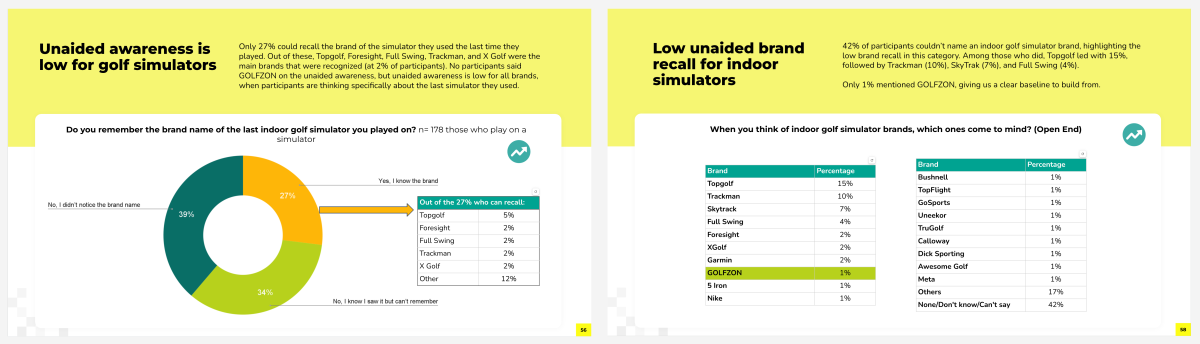
Understanding the gap between recognizing a brand name and recalling it without prompting
Identifying meaningful differentiators and priority audiences
Translating the findings into recommendations for positioning, messaging, and targeting
Our approach
Bixa designed a consistent brand tracker combining comparable measures over time (awareness, consideration, conversion, perception of our client and its key competitors) along with space for a flexible set of questions each quarter for emerging business priorities.
Our approach included:
Establishing a benchmark: A quantitative study of U.S. golfers explored brand awareness, simulator experience, playing habits, competitive perceptions, and brand associations.
Tracking progress each quarter: Consistent core questions allow GOLFZON to compare results across waves. Flexible questions address current campaigns, product priorities, and new market questions.
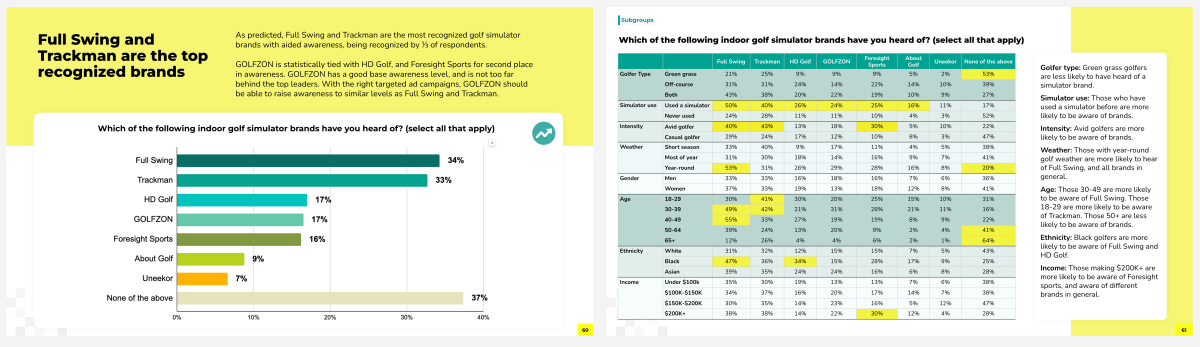
Looking beyond the overall results: Subgroup analysis explores differences by golfer type, simulator experience, playing intensity, skill level, motivation, and demographics. Statistical testing helps distinguish meaningful differences from variation in the sample.
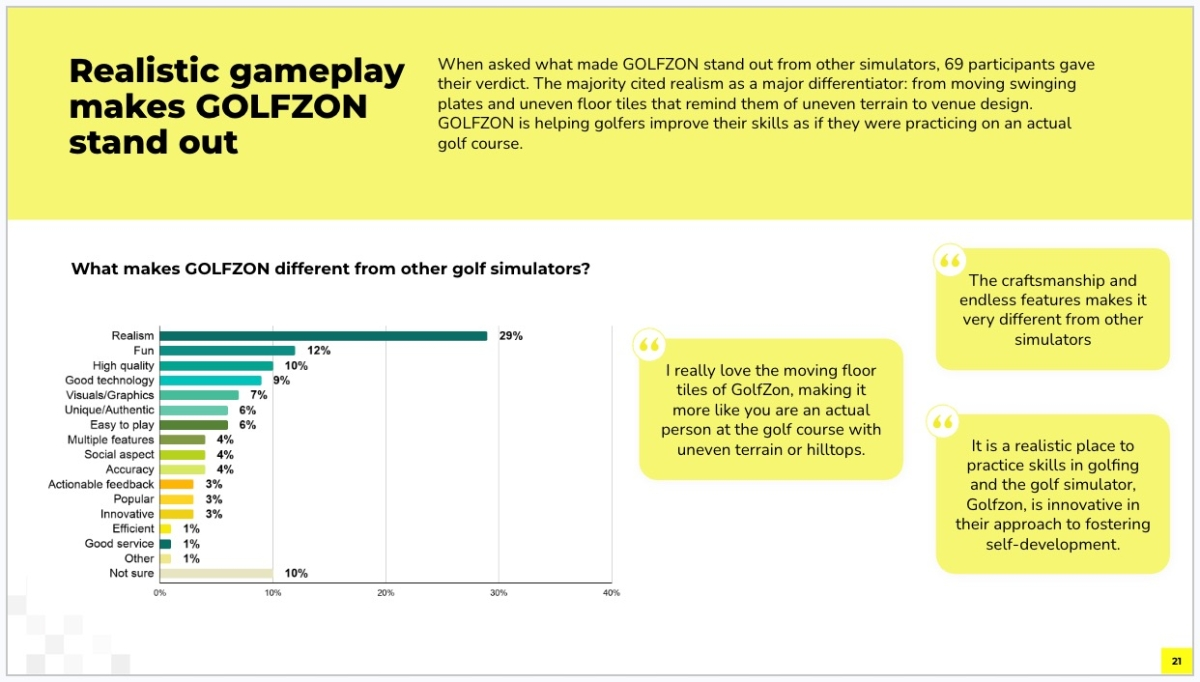
Hearing how golfers describe the experience: Open-ended feedback reveals the language and specific experiences behind brand perceptions, adding context to the numbers.
Informing timely marketing decisions: Each survey has a planned section for flex questions to assess anything that’s top of mind for the marketing team. For instance, gathering target audience feedback on specific concepts for golf lessons or potential ambassador partnerships.
Making the findings useful across the team: Concise executive summaries highlight the most important implications for leadership, while detailed charts, trends, and subgroup analysis support marketing planning.
What we accomplished
Turned brand tracking into a tool for growth decisions
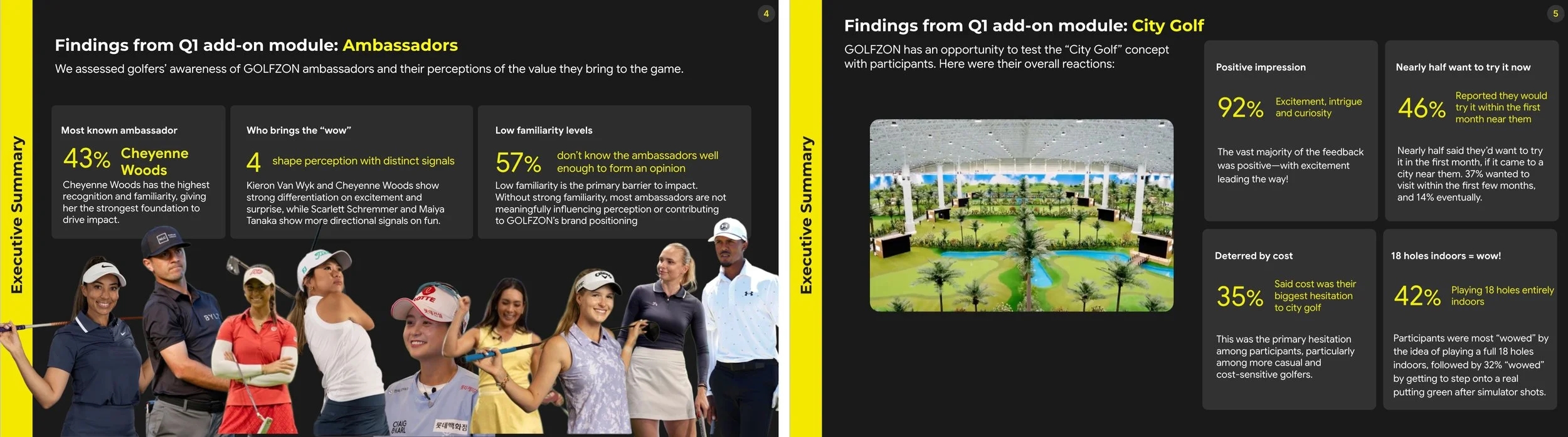
GOLFZON gained a quarterly view of its brand health and competitor momentum, helping the team distinguish temporary attention from sustained awareness. Flexible questions extended the tracker’s value to timely decisions, including evaluating professional golfers for potential ambassador partnerships before committing.
Identified a positioning opportunity grounded in customer experience
The research revealed realistic gameplay as GOLFZON’s leading perceived differentiator. Golfers connected that realism to tangible features, giving the team customer language and product proof points to sharpen messaging and explain why GOLFZON stands out.
Pinpointed audiences to prioritize for U.S. growth
Detailed subgroup analysis showed where GOLFZON already had traction and where awareness needed building. The findings gave the marketing team clear direction for targeting, media, partnerships, and market development—moving beyond broad golfer demographics to the behaviors and experiences associated with stronger brand resonance.
A peek behind the curtain

Highlighted tools & techniques

Brand tracking
Uses recurring surveys (typically quarterly or semi-annually) to track how brand awareness, consideration, perceptions, preference, trust, and other key brand metrics change over time. It shows whether your brand and marketing efforts are actually shifting how the market sees you—and where you stand relative to competitors.
Quantitative survey
A large-scale survey with your precise audience puts real numbers behind what you’re hearing or suspecting—providing reliable data to validate assumptions, size opportunities, and make confident decisions.
Competitive benchmarking
Measures your brand, product, or customer experience against key competitors using a consistent set of criteria. It shows where you lead, where competitors have an advantage, and where there may be opportunities to differentiate or raise the bar.
More case studies
-
![]()
Google News
Audience segmentation & product recommendations for enhanced engagement
-
![]()
Cox Communications
Market validation to empower smarter cities
-
![]()
Google Mobile Youth Task Force
Mapping Gen Z’s online search behavior
-
![]()
She Should Run
Mixed-method research to uncover women’s political motivations



Could you be our next success story?
Book a complimentary 30-minute consultation with a senior researcher at Bixa—never a sales rep.
We’ll discuss your goals and explore how market research can help you accomplish them.
No strings, no commitment. Just clarity.