

Case Study
Understanding women’s motivations to run for political office for She Should Run

She Should Run, a national nonprofit working to increase women’s representation in elected office, partnered with Bixa to understand what motivates women to consider running—and what prevents them from taking the next step.
Bixa combined qualitative research, UX testing, and quantitative psychographic segmentation to look beyond demographics. The study revealed distinct mindsets, emotional drivers, barriers, and decision-making patterns among women considering political office. These insights gave She Should Run a data-backed framework for identifying high-potential audiences, tailoring its messaging, and investing its resources where they could have the greatest impact.
The challenge
Existing research had identified several predictors associated with women running for political office—such as participating in team sports, attending a single-gender school, holding leadership roles, or gaining early exposure to campaigns through a parent. But these factors did not explain the personal and emotional process behind deciding to run.
To strengthen She Should Run’s outreach and impact, the organization needed to understand what transforms political interest into action: the motivations that make elected leadership feel meaningful, the internal barriers that create hesitation, and the experiences that help women begin to see themselves as candidates. Bixa designed a research study to:
Uncover the emotional motivations, fears, and internal barriers shaping women’s decisions to run
Identify the mindset shifts and personal turning points that move women from interest to action
Develop psychographic audience segments based on motivations, attitudes, and readiness—not demographics alone
Understand what different groups of women need at each stage of the candidate journey
Determine which messages, resources, and touchpoints are most likely to build confidence and encourage action
Create actionable personas and journey maps to guide outreach, programming, and resource allocation
Bixa’s mixed-methods nonprofit market research uncovered the personal experiences and broader patterns shaping women’s paths to political leadership. Our approach included:
Literature review: Bixa reviewed existing publications on women’s political participation to identify knowledge gaps and ensure the study added meaningful new insights to the existing body of academic research.
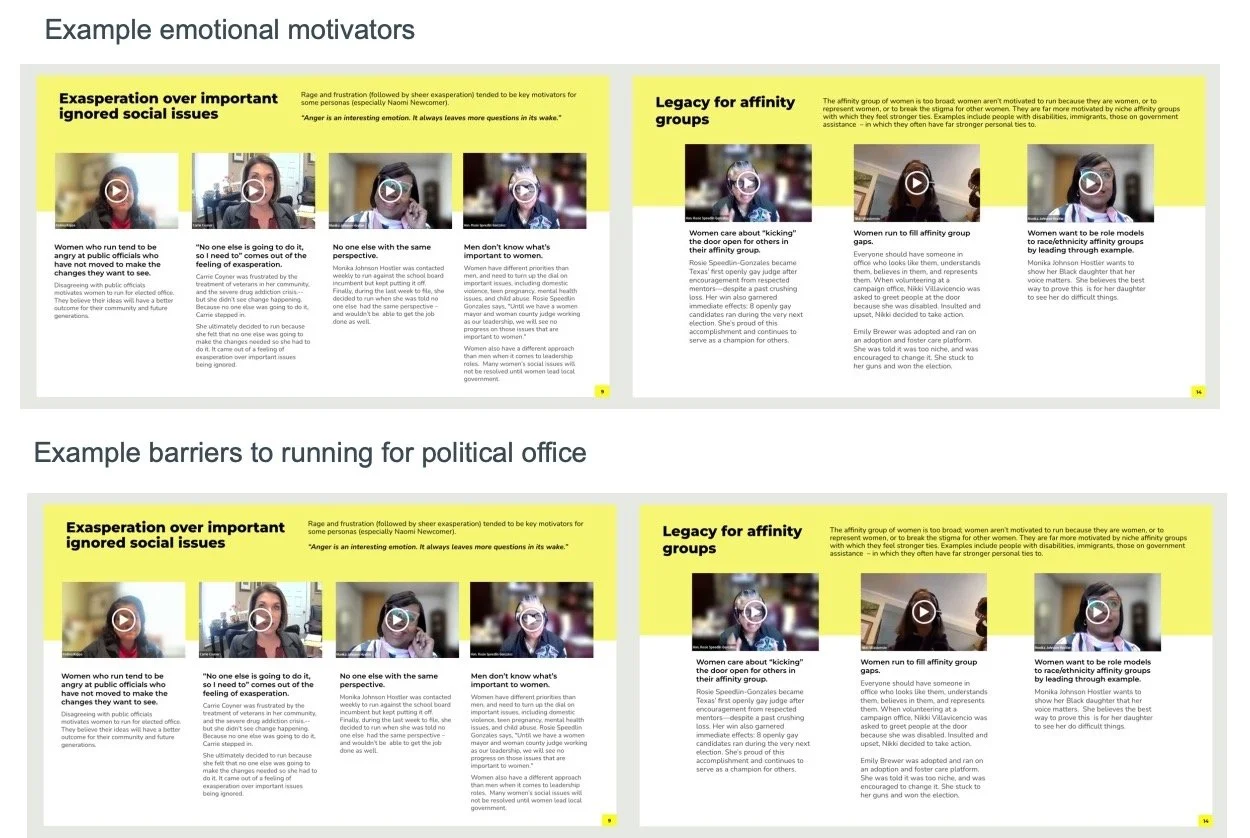
In-depth interviews with elected officials: Women serving in office shared the experiences, barriers, and turning points that influenced their journeys from considering a run to becoming candidates through moderated qualitative interviews.
National quantitative survey: Bixa surveyed women who were considering political office but had not yet filed to run. The survey explored this early stage of the candidate journey, including how running for office first entered their awareness and became an option they could realistically imagine pursuing.
Psychographic audience segmentation: Cluster analysis identified distinct audience segments based on women’s motivations, mindsets, barriers, and likelihood of running for office, and sized the markets for each personas using a proprietary formula that calculates market potential based on reach in terms of TAM/SAM/SOM estimates, impact rating that She Should Run could have on these women’s decision, confidence in the data, and level of effort to reach each specific audience.
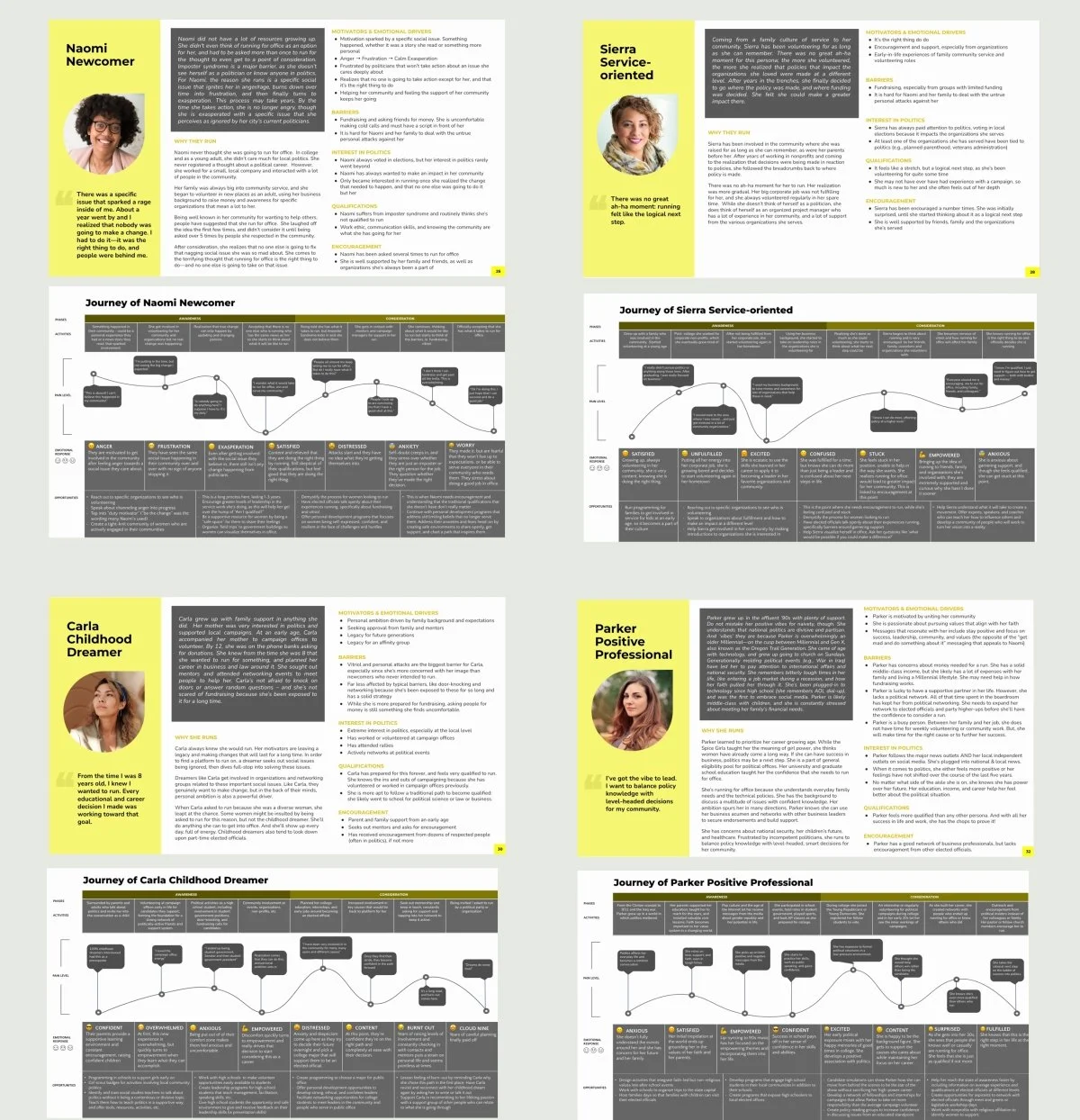
Personas and candidate journey maps: Bixa translated the findings into practical tools that showed what each segment needed and which touchpoints could help women progress toward candidacy.
UX testing: Potential candidates evaluated She Should Run’s digital resources, helping Bixa identify engagement patterns, usability barriers, and opportunities to better support users.
Our approach
What we accomplished
Refined audience targeting
Pinpointed high-potential audience segments based on size, engagement readiness, and alignment with the organization’s mission.
Optimized resource allocation
The segmentation framework helped She Should Run direct its limited time, funding, and program resources toward the audiences with the greatest potential for measurable impact.
Tailored engagement strategy
Candidate journey mapping revealed the messages, resources, and touchpoints most likely to move women from interest to action. She Should Run could use these insights to personalize outreach and provide more relevant support throughout the candidate journey.
A peek behind the curtain

Highlighted tools & techniques

Cluster analysis
A statistical model for audience segmentation and persona creation that identifies meaningful groups of customers based on shared behaviors, needs, motivations, or attitudes. This gives you real data to determine who to target (and who not to target) while informing differentiated messaging, products, and go-to-market strategies.
Quantitative survey
Collects structured data from a large audience to understand behaviors, attitudes, and motivations at scale. It reveals broad trends, measures differences between groups, and provides the evidence needed to validate qualitative insights and guide strategic decisions.
Journey mapping
Maps the customer experience from beginning to end to show what people are doing, thinking, feeling, and needing at each stage. It pinpoints moments of friction, unmet needs, and opportunities to improve the experience—and helps teams see how individual touchpoints connect to the bigger picture.
More case studies
-
![]()
Google News
Audience segmentation & product recommendations for enhanced engagement
-
![]()
Cox Communications
Market validation to empower smarter cities
-
![]()
Let'sGetChecked
Long-term research to identify at-home healthcare opportunities
-
![]()
Google Mobile Youth Task Force
Mapping Gen Z’s online search behavior




Could you be our next success story?
Book a complimentary 30-minute consultation with a senior researcher at Bixa—never a sales rep.
We’ll discuss your goals and explore how market research can help you accomplish them.
No strings, no commitment. Just clarity.