

Case Study
Unveiling the future of at-home healthcare with LetsGetChecked

LetsGetChecked, a leading at-home diagnostic testing provider, partnered with Bixa to understand how Americans experience healthcare—and where at-home testing and telehealth could make care more accessible.
For two consecutive years, Bixa conducted a nationally representative healthcare study in the form of a quantitative survey, supported by video diary research. This longitudinal research tracked changing attitudes toward healthcare access, affordability, health equity, virtual care, and at-home testing.
The findings gave LetsGetChecked original data and real patient stories to support a flagship healthcare whitepaper (see their landing page and downloadable PDF whitepaper), product planning, marketing, media outreach, and investor communications.
The challenge
LetsGetChecked wanted credible data about Americans’ healthcare experiences and how their expectations for at-home care were changing over time. The research was designed to:
Identify challenges in traditional healthcare such as cost, access and health literacy.
Define the ideal future state of accessible, affordable at-home healthcare.
Explore public perceptions of telehealth, home diagnostic testing, and medication delivery.
Highlight health equity gaps, and identify ways to serve underserved communities.
The study also needed to represent populations whose healthcare experiences are often overlooked, including LGBTQIA+ populations and people with disabilities.
Our approach
Bixa combined nationally representative survey research with video diaries to connect large-scale trends with real patient experiences.
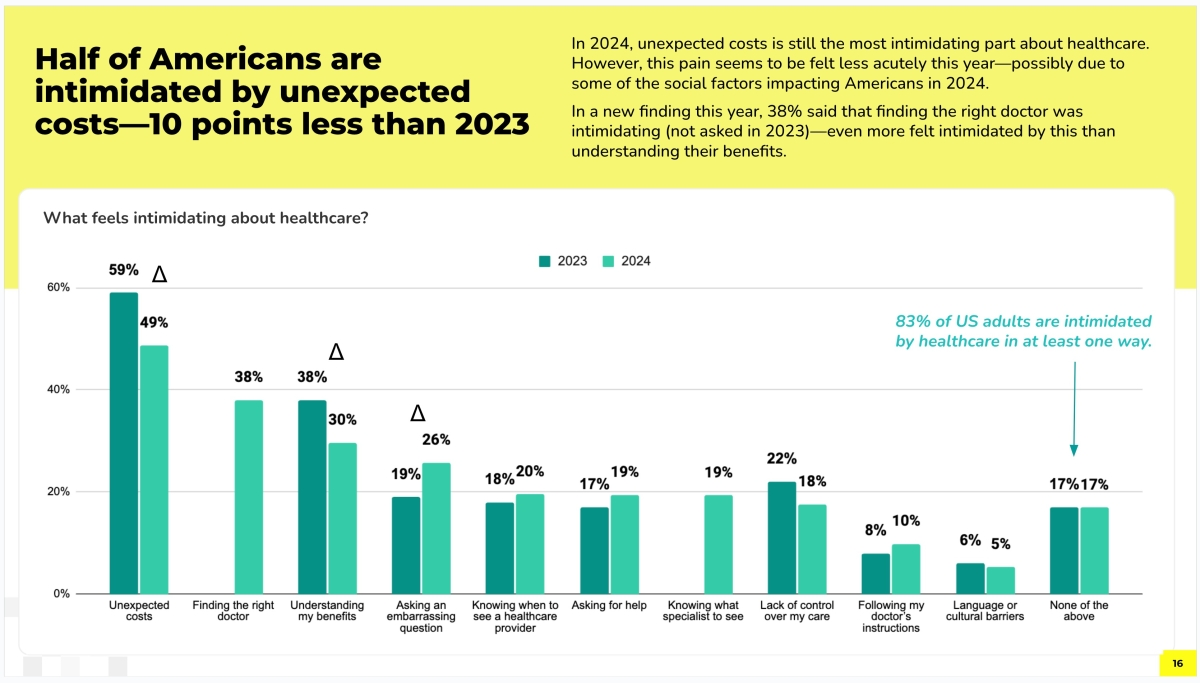
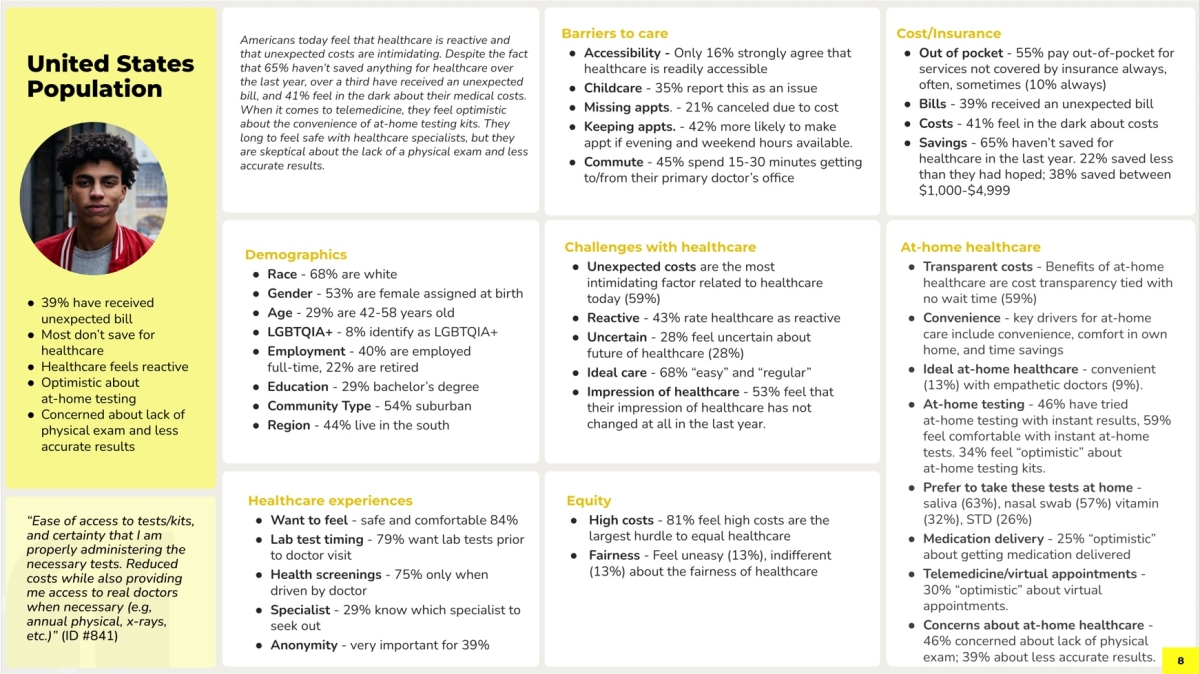
National healthcare survey: Bixa surveyed over 1,200 U.S. adults each year using a sample aligned with U.S. Census benchmarks. The survey measured perceptions of healthcare costs, access, health equity, telehealth, medication delivery, and at-home testing.
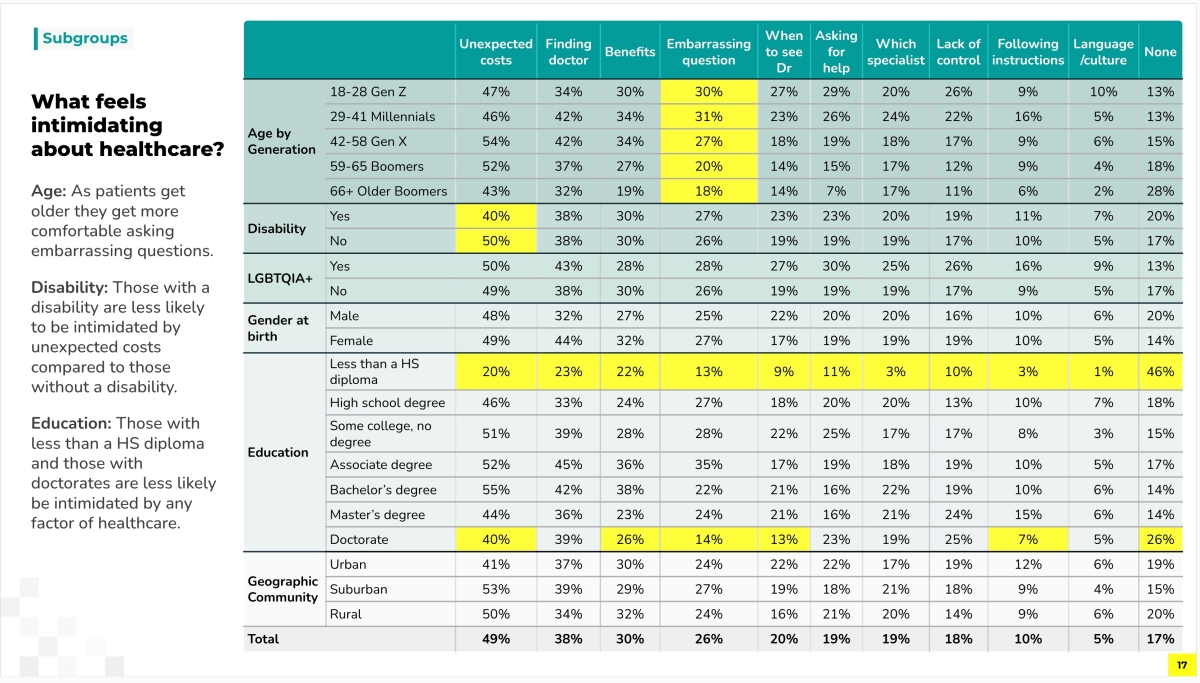
Inclusive sampling: The study included an additional 200 respondents from the LGBTQIA+ community and 200 respondents with disabilities. Statistical weighting preserved national representation while allowing Bixa to examine the experiences of these groups in greater detail.
Statistical analysis: Bixa cleaned and analyzed the data in SPSS, identifying major trends and statistically significant differences across demographic groups. For the overall sample, the survey had a margin of error of ±3% at a 95% confidence level.
Longitudinal tracking: Bixa created a repeatable survey and analysis framework and conducted the research for two consecutive years. Comparing results across waves allowed LetsGetChecked to identify statistically significant shifts in healthcare attitudes, behaviors, and expectations over time.
Video diary research: Participants shared personal stories about seeking care, interacting with providers, and using telehealth and at-home healthcare. With participant consent, selected recordings were used in marketing and communications.
What we accomplished
Established thought leadership & industry influence with original research
Bixa transformed the findings into original thought-leadership content for LetsGetChecked’s healthcare whitepaper. The downloadable report gave the company a valuable lead-generation asset while supporting media outreach and industry conversations about health equity and at-home care.
Tracked changes in perceptions of American healthcare over years
This longitudinal study showed how perceptions of healthcare costs, access, telehealth, and at-home testing changed over two years. This gave LetsGetChecked a stronger evidence base for identifying emerging needs, shaping product strategy, and contributing timely insights to the healthcare conversation.
Strengthened marketing and investor engagement with real patient stories
Participant-recorded video diaries brought the survey findings to life through firsthand healthcare experiences. LetsGetChecked used approved clips in marketing campaigns and investor presentations, helping the company build trust with consumers and communicate its mission and real-world impact to investors.
A peek behind the curtain



Highlighted tools & techniques

Quantitative survey
A large-scale survey with your precise audience puts real numbers behind what you’re hearing or suspecting—providing reliable data to validate assumptions, size opportunities, and make confident decisions.
Video diaries
Participants record unmoderated videos, capturing experiences, behaviors, and reactions as they happen rather than trying to recall them later. This gives you an authentic window into customers’ real lives—including the context, emotions, and unmet needs that can be difficult to uncover in a traditional interview.
Brand tracking
Uses recurring surveys (typically quarterly or semi-annually) to track how brand awareness, consideration, perceptions, preference, trust, and other key brand metrics change over time. It shows whether your brand and marketing efforts are actually shifting how the market sees you—and where you stand relative to competitors.
More case studies
-
![]()
Eko Health
Data-driven product strategy for AI-powered stethoscopes
-
![]()
She Should Run
Mixed-method research to uncover women’s political motivations
-
![]()
Google Ads
An exploration of Gen Z’s expectations around advertising
-
![]()
Cox Communications
Market validation to empower smarter cities




Could you be our next success story?
Book a complimentary 30-minute consultation with a senior researcher at Bixa—never a sales rep.
We’ll discuss your goals and explore how market research can help you accomplish them.
No strings, no commitment. Just clarity.