

Case Study
Exploring what draws women toward an MBA for Forté Foundation
An MBA can promise new opportunities. But before a young learner considers applying, she needs to see how those opportunities fit her life—and whether they justify the cost, time, and uncertainty of returning to school. Forté Foundation partnered with Bixa to understand how early-career women view graduate business education, which audiences are most open to an MBA today, and what messages made the possibility more compelling.
With a survey of over 200 young career women, Bixa conducted quantitative audience segmentation and MaxDiff message testing. We identified three distinct personas and clarified the motivations and barriers shaping each of their decisions. These findings gave the Forté Fondation direction for focusing outreach, tailoring messaging, and helping prospective students picture what an MBA could make possible.
The challenge
Career ambition doesn’t translate automatically into interest in business school. Women considering their next move can choose among graduate degrees, professional certifications, online courses, or a job change. An MBA needs to earn its place among those options.
The Forté Foundation, a nonprofit whose mission is to get more women to consider an MBA, needed to understand which audiences were most receptive, what separated women ready to pursue leadership from those uncertain whether business school belonged in their future, and what each group needed to take to the next step.
The research focused on:
Identifying and prioritizing audiences most likely to consider an MBA.
Understanding how women weigh graduate education against other paths to career advancement.
Exploring the financial, practical, and personal barriers that affect consideration.
Examining the roles of confidence, professional networks, and visible role models.
Determining which messages generated the strongest interest across audiences.
Our approach
Bixa designed quantitative education market research that examined both the appeal of an MBA and the realities surrounding the decision. Our research was designed to connect career aspirations with the decision to return to school for a business degree. Our approach included:
A survey to hear from women making early-career choices. We surveyed over 200 career-oriented women from different backgrounds who had earned their bachelor’s degrees between 2017 and 2025. Qualified participants were those prioritizing goals such as career advancement, increasing income, developing skills, or growing a business.
Analysis to explore a choice of MBA vs. other alternatives. Survey questions examined career goals, education preferences, perceptions of business careers, and what would make an MBA worth the investment. We also explored concerns about cost, time, skills, and fitting school into everyday life.
Audience segmentation by motivations and attitudes. Cluster analysis identified groups with shared priorities, beliefs, and behaviors. Bixa translated those patterns into three audience personas that explained different relationships with business education.
Message prioritization through advanced modeling. The Bixa team conducted a MaxDiff survey question type and statistical analysis to evaluate the effectiveness of 20 potential messages, all with unique framing for getting an MBA. Across repeated sets, participants selected the statements that made them most and least excited about growing their careers—helping distinguish stronger messages from weaker ones.
Analysis of subgroups for a more nuanced answer to what messaging Forté should use. We compared messaging rankings across personas to understand where a broad campaign could connect, and where different audiences needed a unique approach.
What we accomplished
Identified where Forté could focus its outreach
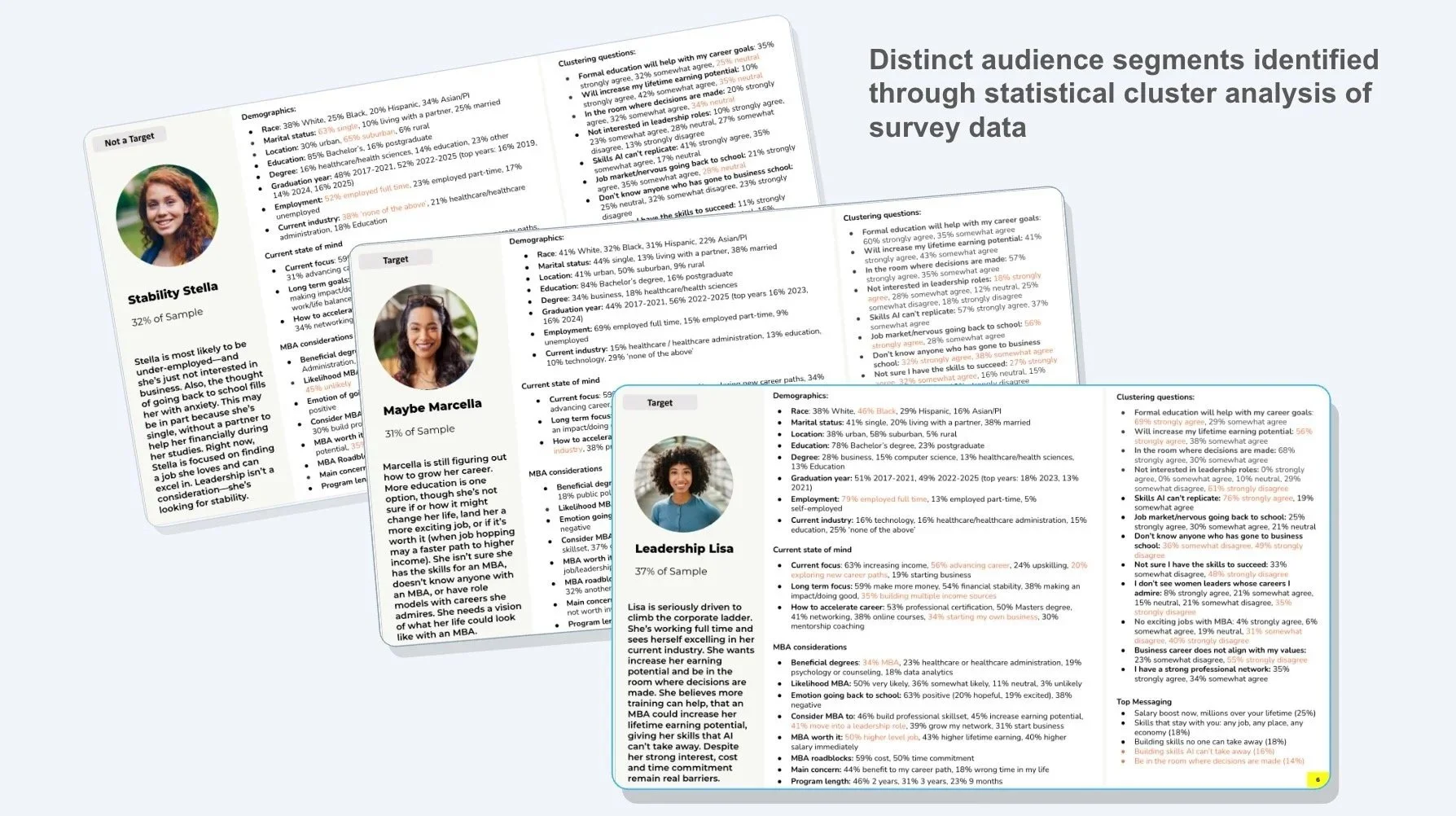
The segmentation revealed three distinct personas: one who could already picture herself advancing into leadership who inherently saw value in business education but still faced real cost and time barriers; another who strived for career growth but lacked a clear picture of what change an MBA would make in her life; and a third audience who prioritized financial security and finding fulfilling work but showed substantially less interest in business education.
These distinctions gave Forté a baseline for deciding where to concentrate its effort and investment dollars, and how to approach women in different audience groups and at different stages of consideration. Bixa also developed a few questions Forté could use to quickly place a prospect into a persona, with the goal of being able to speak more acutely to her underlying needs.
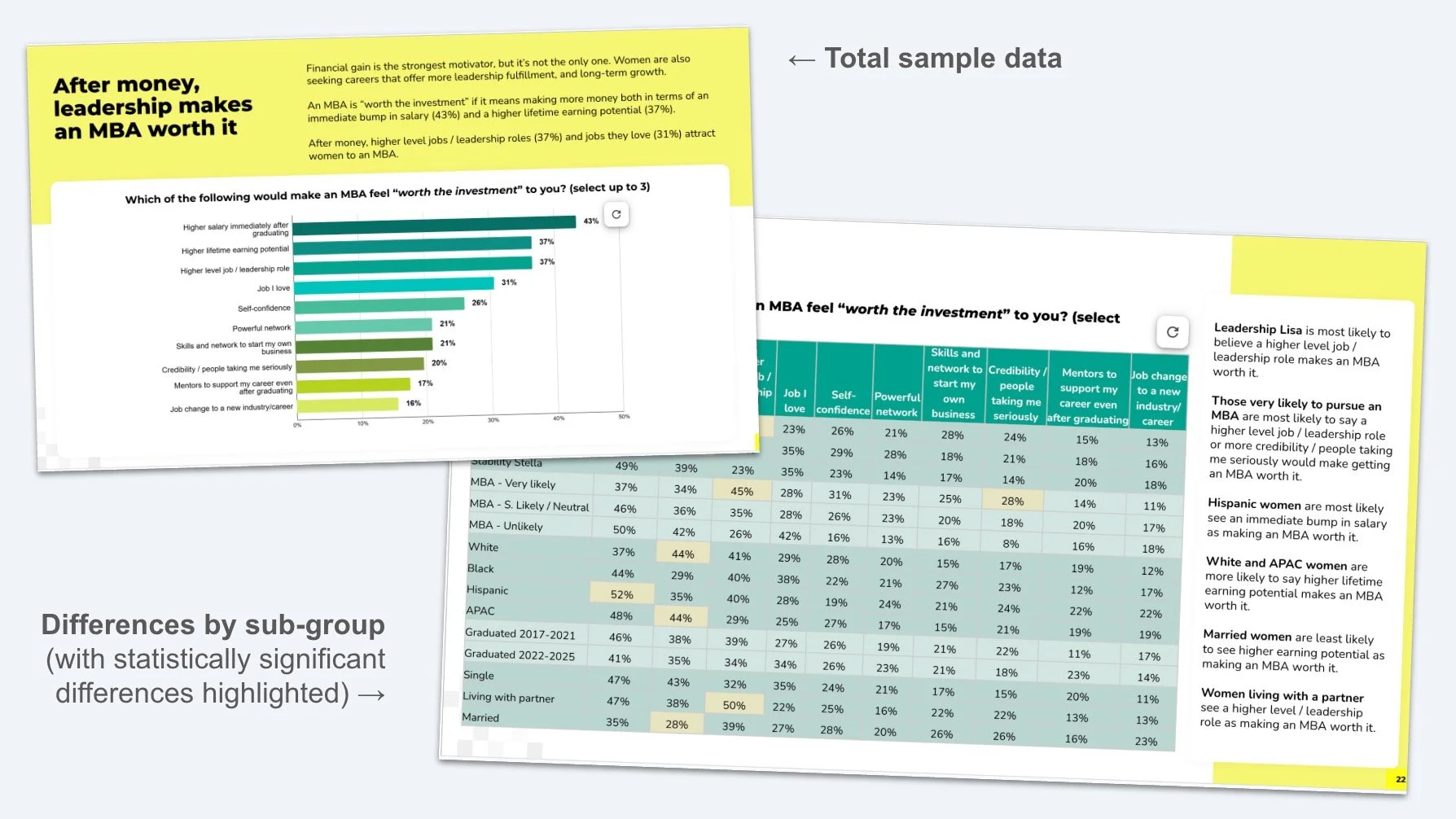
Clarified what would make an MBA “worth the investment”
Respondents evaluated an MBA through the opportunities it could create. Higher earnings mattered, alongside access to leadership, stronger professional skills, and work they would enjoy.
Cost and time remained substantial obstacles, including among women already interested in the degree. The findings pointed toward outreach that pairs an appealing career vision with practical support for evaluating the commitment.
Separated uncertainty from lack of interest, and identified message that could move the needle
Women who hesitated did not all need the same response. For some, business school aligned with their ambitions, but the logistics felt difficult. Others struggled to imagine the outcome, questioned their skills, or lacked visible examples of women whose careers they wanted to emulate. Bixa’s research gave Forté direction for addressing those different needs.
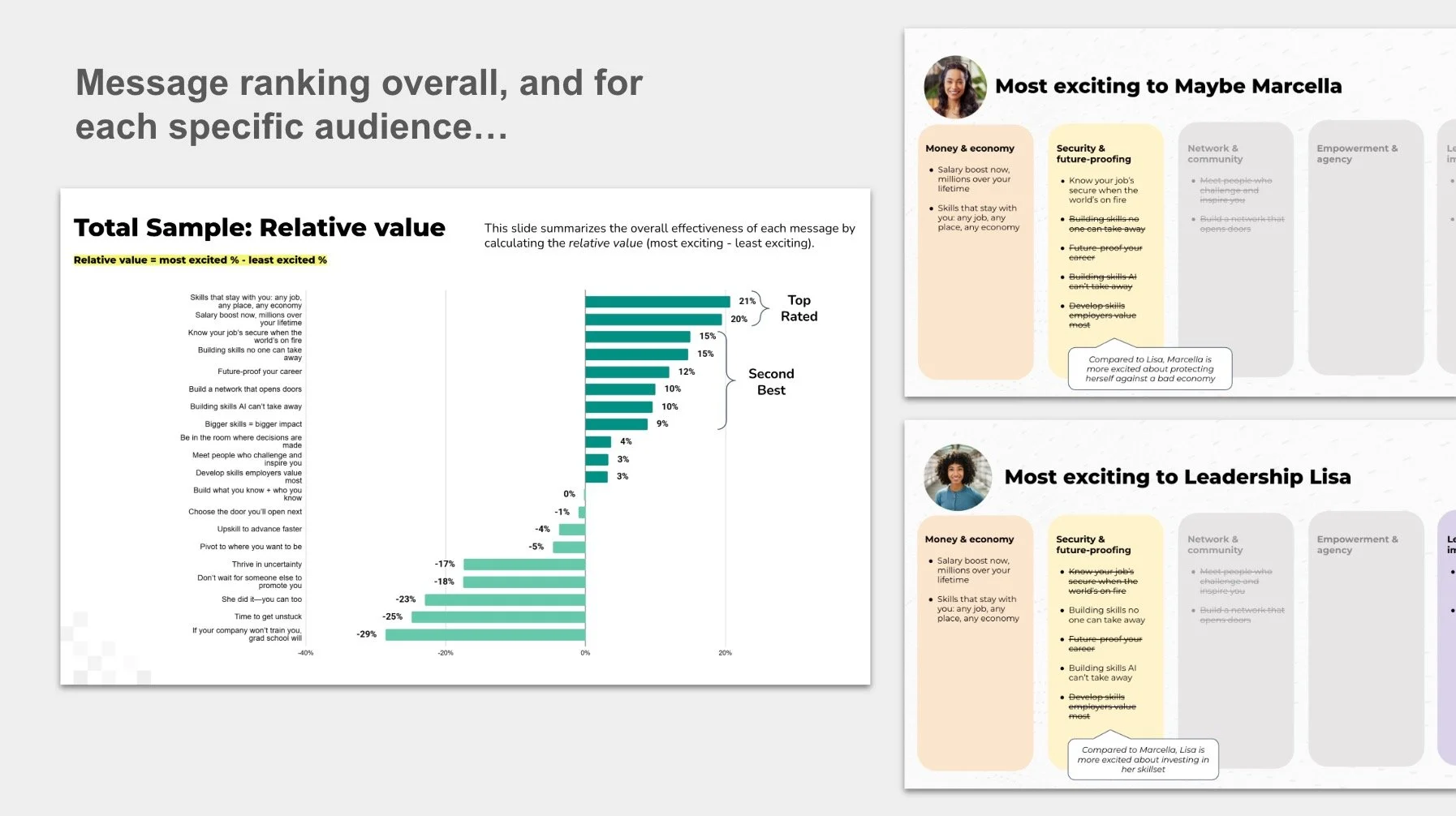
MaxDiff testing showed the broad appeal of messages related to lasting skills and earning potential, but it also revealed meaningful differences beneath the total results. Leadership-oriented women responded more strongly to messages about gaining influence and building skills that AI could not replicate, for example. These findings helped Forté distinguish broadly appealing themes from messages better suited to a specific audience.
A peek behind the curtain
Highlighted tools & techniques

Cluster analysis for audience segmentation
This advanced survey method is used to product features, brand messaging, benefits, or other competing ideas. By forcing respondents to make choices, it avoids the “everything is important” finding and creates a clear hierarchy of what matters most (and least).
MaxDiff for message testing
This advanced survey method is used to product features, brand messaging, benefits, or other competing ideas. By forcing respondents to make choices, it avoids the “everything is important” finding and creates a clear hierarchy of what matters most (and least).
Quantitative survey
A large-scale survey with your precise audience puts real numbers behind what you’re hearing or suspecting—providing reliable data to validate assumptions, size opportunities, and make confident decisions.
More case studies
-
![]()
Google News
Audience segmentation & product recommendations for enhanced engagement
-
![]()
Cox Communications
Market validation to empower smarter cities
-
![]()
Google Mobile Youth Task Force
Mapping Gen Z’s online search behavior
-
![]()
She Should Run
Mixed-method research to uncover women’s political motivations




Could you be our next success story?
Book a complimentary 30-minute consultation with a senior researcher at Bixa—never a sales rep.
We’ll discuss your goals and explore how market research can help you accomplish them.
No strings, no commitment. Just clarity.