
The Hidden Audience Research Behind a Viral Red Carpet Moment
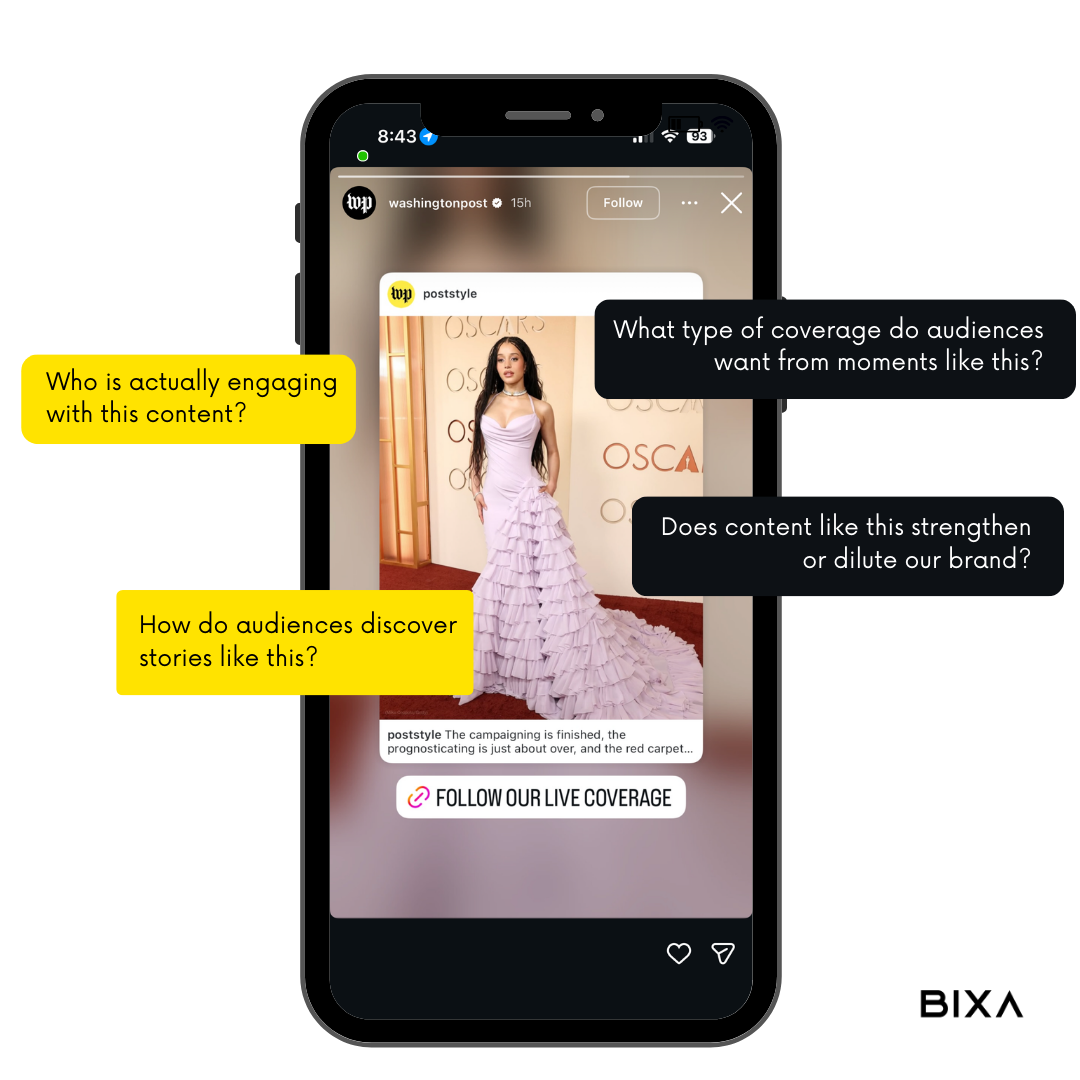
At first glance, this looks like a typical entertainment post from a news organization.
A celebrity on the red carpet.
A quick caption.
A link to live coverage.
Simple, right?
But behind moments like this are some of the most important questions media companies face today. Because when a story like this appears in someone’s feed, editors and product teams are quietly asking things like:
Who is actually engaging with this content?
How did audiences discover this story?
What type of coverage do readers want from cultural moments like this?
Does this type of content strengthen or dilute the brand of a news organization?
These aren’t just editorial questions.
They’re audience research questions.
Media organizations are navigating a complicated landscape
The way people consume media has changed dramatically. Audiences don’t just discover stories on a homepage anymore. They find them through:
social feeds
algorithmic recommendations
creator platforms
search
push notifications
A single cultural moment — like a red carpet appearance — can travel across platforms and reach audiences that might not otherwise engage with a news brand.
Understanding who those audiences are and what they want is where research becomes essential.
The hidden questions behind content strategy
For media companies, moments like this raise deeper strategic questions:
Is this content attracting new audiences or just entertaining existing ones?
Do readers want quick updates, deep commentary, or visual storytelling?
Are we competing with entertainment outlets, influencers, or other news organizations?
Without audience research, these decisions are often based on instinct.
With research, media organizations can see the patterns behind audience behavior.
Audience research reveals the bigger story
When we conduct audience research with media companies, we often uncover insights like:
Different audience segments engage with the same story for completely different reasons.
Some readers come for fashion commentary.
Others for celebrity culture.
Others because the story surfaced in a trending feed.
What looks like a single story is often actually multiple audiences interacting with content in different ways.
Understanding that difference helps media organizations:
Design better content strategies
Improve audience growth
Strengthen engagement across platforms
Watching How People Actually Read the News
One of the biggest challenges media organizations face today is that audiences rarely consume news in a single place.
Readers move fluidly between social platforms, news aggregators, direct website visits, newsletters, and mobile apps. Traditional analytics can show traffic patterns, but they rarely reveal what audiences are actually doing in the moments leading up to a click—or what happens after.
That’s where qualitative audience research becomes incredibly valuable.
In one project Bixa conducted with The Atlanta Journal-Constitution (AJC), we used video diary studies and screen recordings to observe how people naturally interact with news content in their everyday lives. Participants recorded their screens while browsing social media feeds and encountering news posts organically. When they clicked on stories from outlets like the AJC, we captured exactly what they saw and how they navigated the content.
This allowed us to analyze questions such as:
What makes someone stop scrolling and click on a news post?
How do readers evaluate headlines, images, and captions before deciding to engage?
Once they open an article, what keeps them reading—or causes them to leave?
Because we were observing real behavior in the moment, the research revealed patterns that traditional analytics alone couldn’t explain. For example, we could see how audiences compare multiple headlines before choosing one, how visual cues influence trust, and how quickly readers decide whether a story is worth their time.
These insights helped inform decisions about headline framing, story packaging for social platforms, and how articles are structured once readers arrive on the page.
In another study focused on Google News and aggregator-driven discovery, participants completed a four-day video diary documenting every time they checked the news throughout their day.
Each time news viewers opened a news app or website, they recorded their screen and narrated what they were doing. This allowed us to capture the full context around news consumption, including:
How frequently people check news across the day
Which platforms they turn to first
How they evaluate competing headlines in aggregators like Google News
What motivates them to open one story over another
How long they spend with an article before moving on
News consumption is highly contextual. People check news in quick bursts—between meetings, while commuting, during short breaks—and their expectations change depending on the platform and the moment. That insight helped inform decisions about:
How stories should be packaged for aggregators versus social feeds
What headline styles perform best in competitive news environments
How quickly articles need to deliver value once someone clicks
Where opportunities exist to deepen engagement once readers arrive
Perhaps most importantly, the research helped teams see how audiences encounter their brand alongside competitors in real-world environments, rather than in isolation.
That perspective often changes how organizations think about content strategy.
What became clear from studies like these is that understanding audience behavior today requires more than traffic metrics. It requires observing how people actually interact with news in their everyday lives.
And increasingly, media organizations—as well as companies in many other industries—are turning to market research to uncover these kinds of insights.
When organizations can see the real behaviors behind clicks, engagement, and content discovery, they’re able to move beyond guesswork and make more confident strategic decisions about the experiences they create for their audiences.
As the media landscape continues to evolve, organizations are realizing that understanding audiences requires more than analytics dashboards or engagement metrics.
Clicks and page views can tell you what happened… But they rarely explain why it happened.
Audience research fills that gap by revealing the motivations, decision-making patterns, and behaviors that drive engagement. By observing how people actually discover content, evaluate headlines, and move through stories, organizations gain insights that can shape everything from editorial strategy to product design.
That’s why more media companies—and increasingly organizations across many industries—are investing in structured research programs that combine behavioral observation, qualitative interviews, and quantitative audience studies. These approaches allow teams to step outside their internal assumptions and see their content, platforms, and brand through the eyes of the people they’re trying to reach.
For organizations navigating a rapidly changing media environment, those insights can make the difference between simply reacting to audience behavior and truly understanding it.
And in a world where attention is one of the most competitive resources, that understanding is more valuable than ever.
The next time you see a story like this…
Remember that it’s not just entertainment coverage.
It’s a real-time test of:
audience behavior
content discovery
platform strategy
brand perception
And the organizations that succeed in modern media are the ones that turn those moments into insight.
“A viral moment might look spontaneous, but for media companies it’s actually a valuable data point. Behind every trending story are questions about audience behavior, discovery, and engagement—and research is what turns those moments into real insight.”
Why companies work with Bixa
When the decision matters, teams call Bixa because they don’t want probability — they want clarity they can stand behind. We conduct human-moderated interviews and rigorous quantitative studies like MaxDiff and Conjoint, and we manually analyze the work because nuance, emotion, and contradiction don’t show up in automated summaries. We’ve partnered with companies ranging from startups to global brands like Google, IBM, and Cvent, and the common thread is simple: they’re making a high-impact decision and need research that understands humans. If that’s where you are, book a no-pressure call with one of our senior researchers — we’ll help you determine the right path forward.
If you’re navigating an important decision and want to pressure-test it with real humans, book a call with one of our senior researchers:


Explore the major market research trends shaping 2026, from faster mixed-method research and first-party insights to data quality, AI, and the changing role of researchers.