
Messaging research: How to test, refine, and strengthen your brand voice
Clear, compelling messaging is one of the most powerful drivers of growth—but it’s also one of the hardest things to get right.
Messaging research helps organizations understand what resonates, what differentiates, and what actually drives action. Whether the goal is refining a value proposition, testing brand positioning, improving campaign performance, or increasing conversion rates, messaging research provides a structured way to identify what works—and why.
At Bixa, every messaging research program starts with the decision you need to make. From there, we design research that connects directly with customers and target audiences—translating feedback into clear, actionable messaging strategies.
How we conduct messaging research at Bixa: A step-by-step guide
Messaging research is most effective when it follows a structured, decision-focused process grounded in real audience feedback. Below is how leading organizations test and refine messaging to improve clarity, differentiation, and conversion.

Step 1Define messaging objectives
Every study starts by identifying what messaging decisions need to be made.
This may include:
Evaluating a value proposition
Testing brand positioning
Comparing messaging directions
Improving marketing or website performance
Understanding what builds trust and credibility
Clear objectives ensure the research focuses on real business decisions—not just general opinions.
In many cases, messaging research also explores how different audiences respond to different messages. What resonates with one segment may fall flat with another. By connecting messaging research with audience segmentation and persona development, organizations can tailor messaging to distinct customer groups—improving relevance, engagement, and conversion.

Step 2Design the research approach
We design a research program tailored to your messaging objectives, often combining qualitative and quantitative research methods.
Messaging research commonly includes:
In-depth interviews to explore reactions, interpretation, and language
Focus groups to observe perception and discussion dynamics
Surveys to measure clarity, appeal, and differentiation
MaxDiff analysis to prioritize messaging and identify what stands out most
A/B-style concept testing to evaluate performance
Video diary studies to capture real-world reactions
MaxDiff is especially powerful in messaging research because it forces trade-offs—helping identify which messages are truly compelling versus simply “liked.”
Many studies are structured in phases so insights from early research inform what gets tested next, improving both efficiency and outcomes.




Step 3Recruit the right audience
Reliable insights depend on speaking with the right people.
Research participants may include current customers, prospective customers, decision-makers, or specialized audiences depending on the goals of the study.
Bixa recruits participants for both B2B and consumer research, including highly specialized audiences such as executives, professional buyers, niche hobbyists, or industry experts. Careful recruitment ensures that research findings reflect real decision makers rather than a generic audience sample.
Step 4Field the research:
test messaging in context
Messaging is evaluated in realistic scenarios—not in isolation.
Participants may be asked to:
React to messaging statements, headlines, or value propositions
Compare multiple positioning directions
Review website copy or landing pages
Respond to campaign concepts or ads
Evaluate messaging within a competitive context
This approach reveals not just what people prefer—but what they understand, remember, and act on.
Step 5Analyze and synthesize insights
We analyze both qualitative and quantitative data to uncover patterns in:
Messaging clarity and comprehension
Differentiation and competitive positioning
Trust, credibility, and emotional response
Conversion drivers and barriers
Differences across audience segments
Qualitative research explains why messaging works, while quantitative research validates what performs at scale.
Insights are analyzed independently first, then synthesized across methods to produce a complete understanding of messaging performance.
Step 6Deliver insights leaders can act on
Insights are translated into clear, decision-ready recommendations.
Deliverables often include:
Refined messaging frameworks and positioning
Prioritized value propositions and key messages
Winning headlines and messaging directions
Audience-specific messaging recommendations
Language aligned with how customers actually think and speak
The goal is not just insight—it’s messaging that improves performance across marketing, product, and sales.
Case study: Using MaxDiff to identify high-performing messaging for different target audiences
When leading event management software company Cvent came to us to us for message testing, we used a quantitative survey technique called MaxDiff (short for Maximum Difference Scaling) to identify their high-performing messaging. Traditionally, MaxDiff is used to understand audience preference for feature prioritization purposes, but at Bixa, we find it tremendously valuable as a tool to understand messaging prioritization as well. Here’s how…
When Cvent came to Bixa for message testing, they had a strong set of potential messages—but like most companies, there were too many to realistically prioritize.
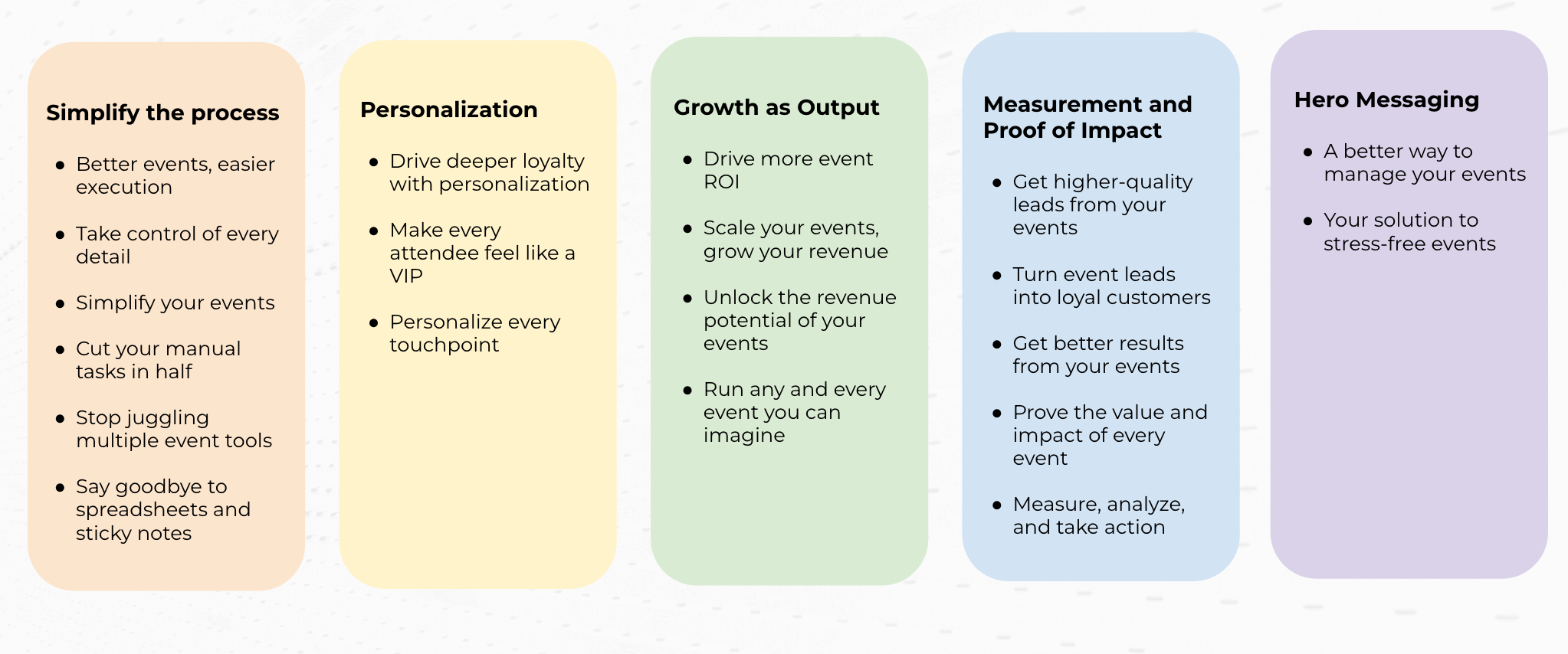
In total, we were evaluating 20 different messaging statements spanning themes like simplification, personalization, growth, and proof of impact.
The challenge? A simple ranking exercise would have overwhelmed respondents and produced unreliable data. People aren’t great at ranking long lists—they default to surface-level choices or inconsistent logic.
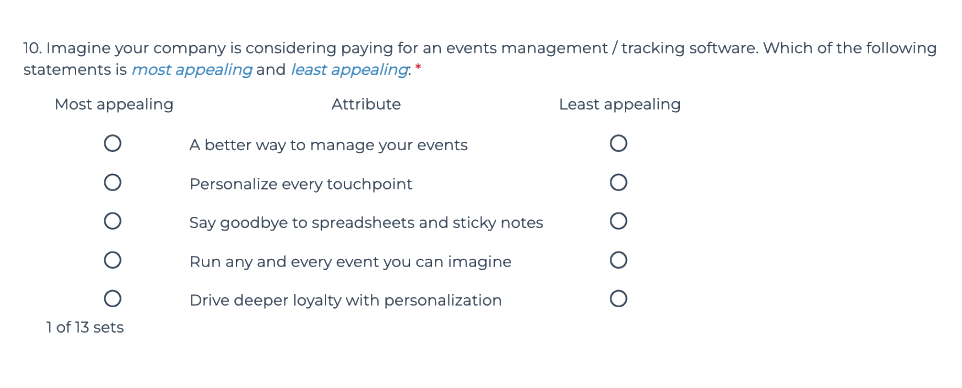
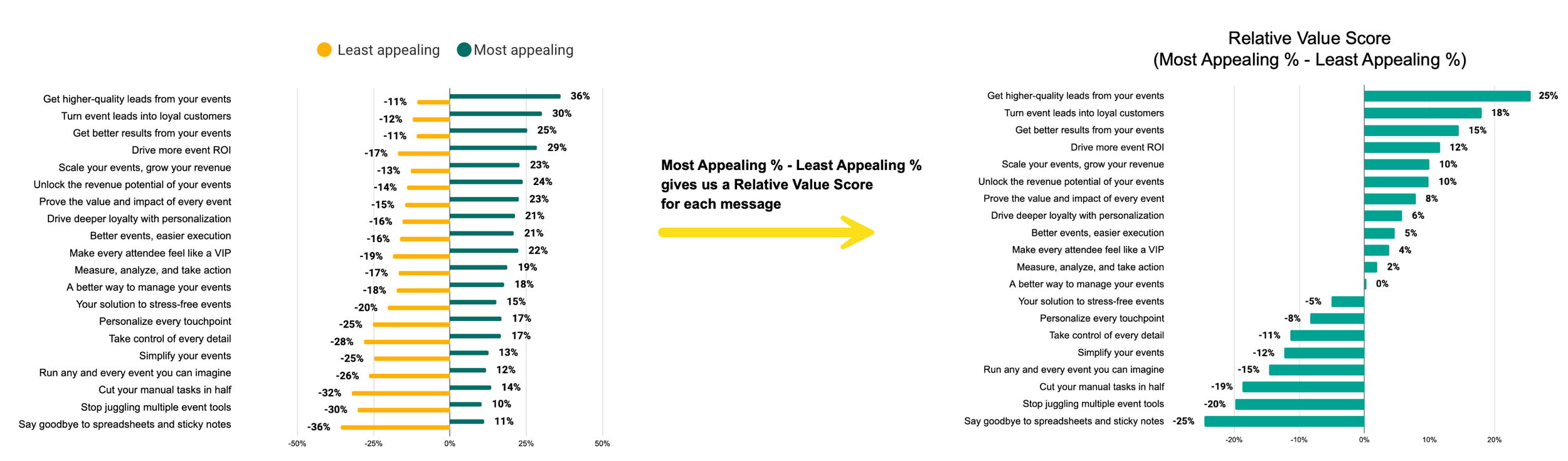
This approach mimics how people actually make decisions in the real world—by comparing a few options at a time—while allowing us to calculate a “relative value score” for each message:
Relative Value Score = Most appealing % – Least appealing %
We were then able to look at the details by audience to find out what resonated best for different target groups. In this case, we were looking at two different job roles: event planners and event marketers. We were also looking at these roles at different company sizes (enterprise company with annual revenue over $750M vs. mid-large sized company with annual revenue under $750M).
These roles do very different things in their job and with event management software, so it only made sense that they would respond to different messaging.
Instead, we used an advanced type of survey question called MaxDiff. Rather than asking people to rank all 20 messages at once, MaxDiff breaks the task into smaller, more realistic decisions.
Participants are shown a small set of messages at a time (typically 4-5 options) and asked two simple questions:
Which message is most appealing?
Which message is least appealing?
This process is repeated in 10-15 sets so that every message is evaluated several times compared to different messages.
Once we analyzed the data, we could clearly see which messages were working—and which were either actively hurting perception or just serving as clutter, distracting from the messaging that was, in fact, hitting home.
Instead of trying to interpret 20 competing messages, we simplified the story:
Messages with positive relative value = resonating
Messages with negative relative value = turning people off or distracting from better messaging
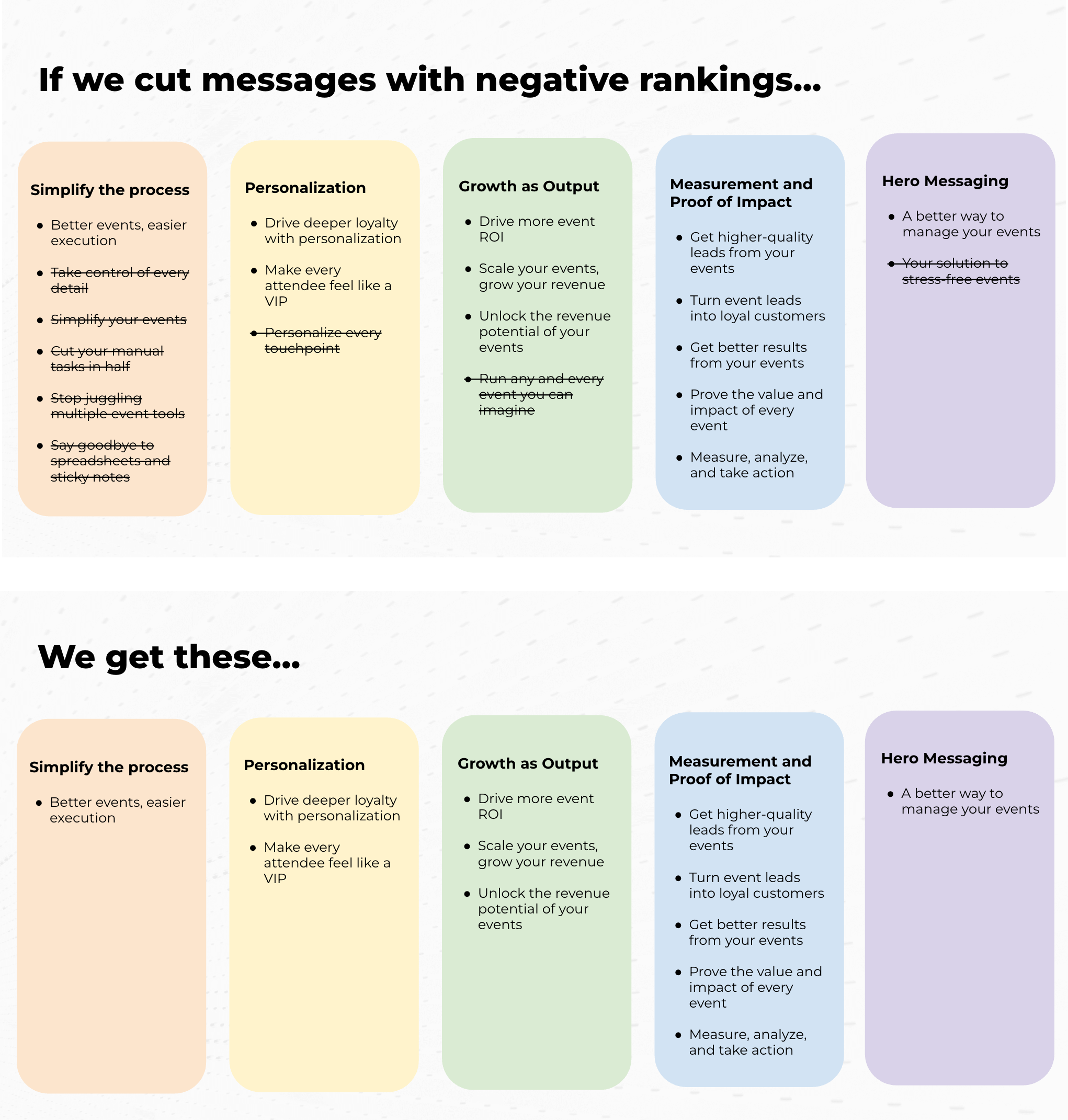
When we removed all messages with negative scores, the messaging became dramatically more focused.
What remained wasn’t just a shorter list—it was a strategically refined set of messages grounded in real audience preference, not internal assumptions.
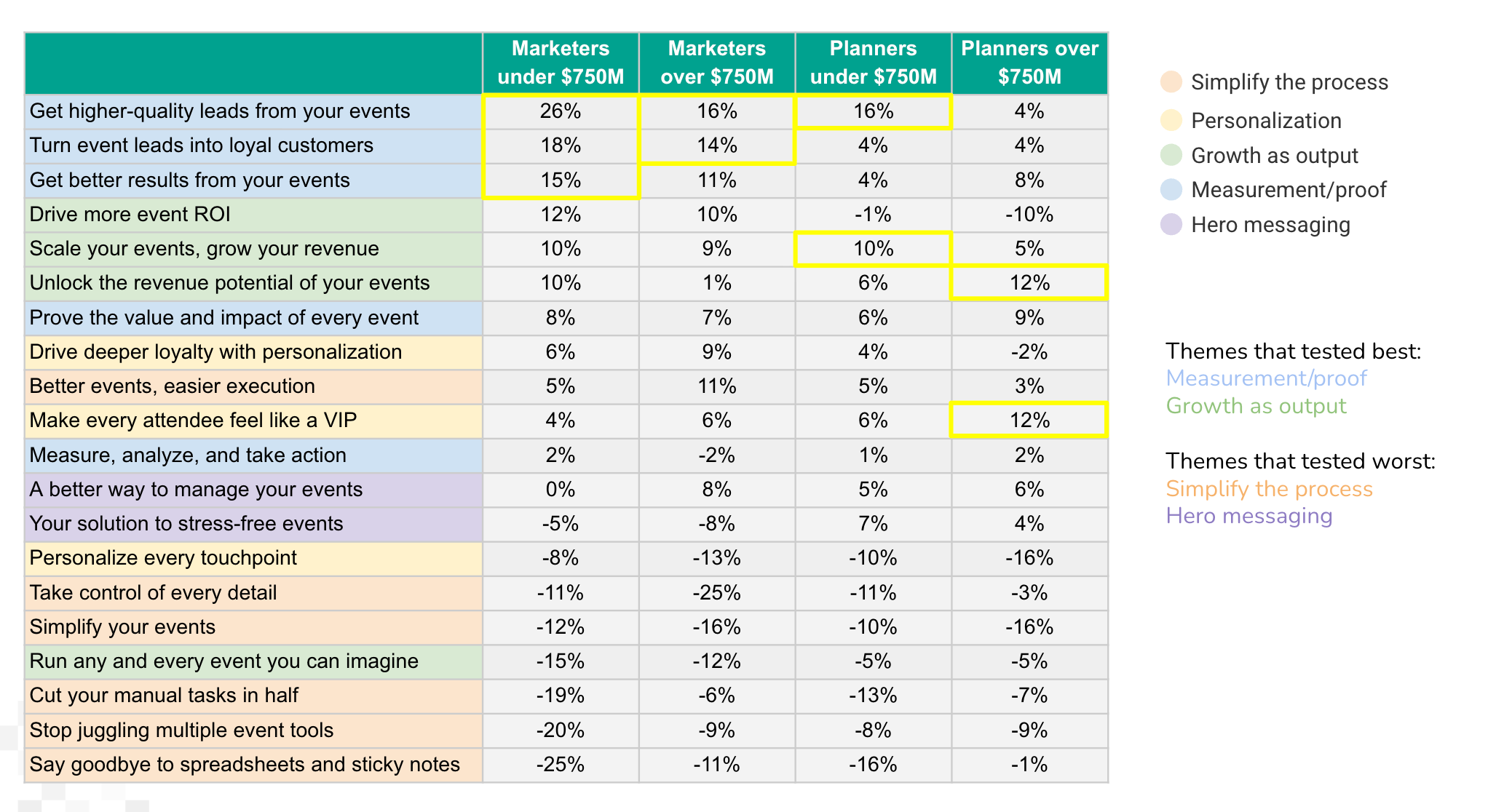
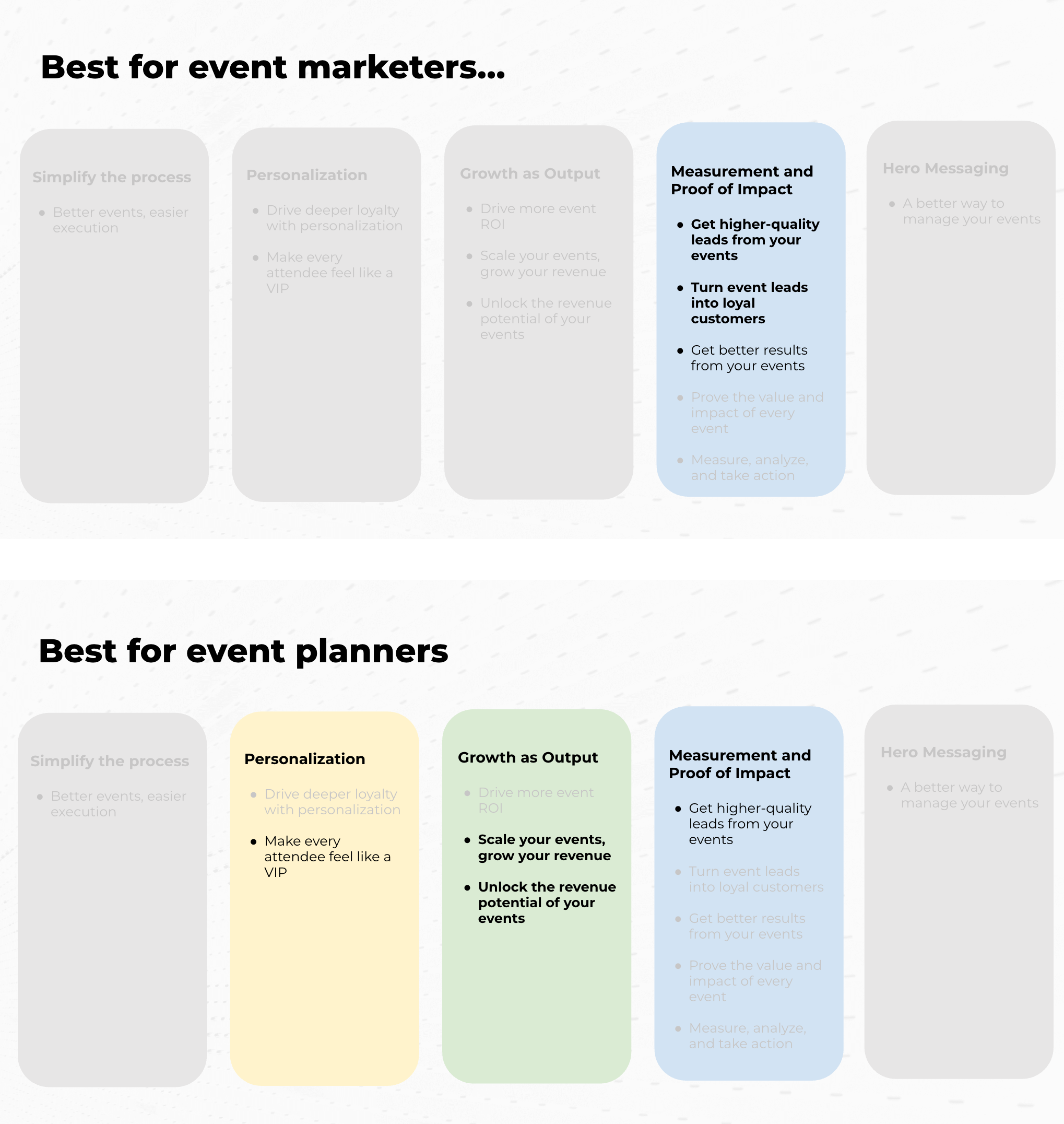
So when we boil it down, we found 2-3 messages out of the original 20 that were most resonant for event marketers, in a single topic area… and 2-4 messages from 20 that were particularly appealing to event planners (across 3 topic areas - with 1 primary one).
This is where messaging research becomes especially powerful. Because in segmenting the data, we found that different audiences responded to different messages—even within the same product.
By using MaxDiff for message testing + audience segmentation, we helped Cvent move from 20 competing messages → to a clear, prioritized messaging strategy
Instead of guessing what might resonate, they now know:
Which messages drive engagement
Which messages hurt or hinder performance
Which messages to use for each audience
And most importantly: our client can now confidently align messaging to the audiences that matter most to their B2B campaigns.
Messaging testing & refinement: How it works and why it matters
How do organizations test brand messaging?
Organizations test brand messaging by exposing target audiences to different value propositions, positioning statements, and campaign concepts, then evaluating how clearly those messages are understood, how differentiated they feel, and how compelling they are in driving interest or action.
This often begins with qualitative research methods—such as in-depth interviews, focus groups, or usability testing—to explore how customers interpret messaging in their own words, what resonates emotionally, and where confusion or skepticism arises. Testing messaging in realistic contexts (like websites, ads, or product pages) helps uncover how it performs in real-world decision-making scenarios.
To validate and prioritize messaging at scale, organizations then incorporate quantitative research methods such as surveys, concept testing, and MaxDiff analysis. These approaches measure which messages stand out, which are most persuasive, and which drive key outcomes like engagement, click-through rates, and conversion intent. By combining qualitative insight with quantitative validation, companies can develop a data-driven messaging strategy that strengthens brand positioning, improves marketing performance, and ensures messaging resonates across different audience segments.
How does messaging research improve conversions?
Messaging research improves conversions by identifying where communication breaks down—whether that’s unclear value propositions, weak differentiation, or friction in how messaging is interpreted by the target audience.
Through qualitative research methods like customer interviews and usability testing, organizations can uncover how real users understand messaging, what feels confusing or irrelevant, and what builds trust. These insights allow teams to refine website copy, landing pages, product messaging, and marketing campaigns so that they align more closely with customer needs, expectations, and decision drivers.
Quantitative messaging research methods—such as surveys, concept testing, and MaxDiff analysis—take this a step further by measuring which messages perform best at scale. By prioritizing the most compelling value propositions and identifying which messaging drives engagement and purchase intent, organizations can optimize for higher conversion rates across channels. The result is not just better messaging, but data-driven messaging strategy that improves customer experience, strengthens brand positioning, and directly impacts business outcomes like lead generation, sales, and revenue growth.

How do you measure which messaging works best?
Messaging effectiveness is measured by evaluating how well different messages perform across key dimensions such as:
Comprehension (is the message clearly understood?)
Differentiation (does it stand out from competitors?)
Appeal (is it engaging and relevant)
Behavioral intent (does it drive interest, clicks, or purchase consideration?)
Organizations test messaging by exposing target audiences to multiple options—such as value propositions, headlines, or positioning statements—and analyzing how each performs against these criteria. This helps identify not just what people like, but what actually influences decision-making.
Quantitative research methods like surveys, concept testing, and MaxDiff analysis are used to measure messaging performance at scale, revealing which messages are most compelling and which fall flat. These methods provide statistically reliable insights into what drives engagement and conversion. Qualitative research—such as customer interviews or focus groups—adds critical context by explaining why certain messages resonate, where confusion exists, and how messaging can be refined. Together, these approaches enable a data-driven messaging strategy that improves clarity, strengthens brand positioning, and increases conversion rates.


Why do companies hire external research firms to conduct messaging research?
Companies hire external research firms to conduct messaging research because objectivity matters. Internal teams are often too close to the product, brand, or strategy, which can unintentionally bias how messaging is developed and evaluated. An independent research partner brings a neutral perspective, designs studies that go beyond internal assumptions, and ensures that feedback reflects how real customers and prospective buyers interpret messaging—not how teams hope it will be received.
External firms also bring specialized expertise and proven methodologies that improve the quality and reliability of insights. This includes designing effective qualitative interviews, applying quantitative tools like MaxDiff to prioritize messaging, and connecting insights across methods to identify what truly drives clarity, differentiation, and conversion. In addition, research partners can recruit the right audiences—including niche B2B decision-makers or hard-to-reach segments—and structure studies in a way that produces actionable recommendations. The result is messaging that is not only validated, but optimized to perform in the real market.

Still have questions about market research? We’ve got answers!
Messaging research can look different depending on your goals—whether you’re refining your value proposition, testing brand positioning, or improving marketing performance and conversion rates.
The process above provides a high-level view of how messaging research works, but every organization approaches it a bit differently. Here you’ll find some answers to some of the most common questions we hear about message testing, value proposition development, brand messaging strategy, and how to improve conversion through customer insights.
If you’re thinking about testing your messaging—or want to understand why your current messaging isn’t resonating—we’re happy to talk it through:
-
Messaging research is the process of testing and refining how a company communicates its value to customers. It helps organizations understand which messages resonate, which are unclear, and which drive engagement and conversion. By gathering feedback directly from customers and target audiences, companies can develop messaging that is clear, differentiated, and aligned with how people actually make decisions.
-
Messaging research is most valuable when launching a new product, repositioning a brand, refining a value proposition, or improving marketing performance. It is also helpful when conversion rates are low, messaging feels inconsistent, or teams are unsure how to clearly communicate their differentiation.
-
Organizations test brand messaging by exposing target audiences to different value propositions, positioning statements, and campaign concepts, then evaluating clarity, differentiation, and appeal. This typically combines qualitative research methods like interviews or focus groups with quantitative approaches such as surveys, concept testing, and MaxDiff analysis to measure performance at scale.
-
Organizations use a wide range of research methods depending on the decision they need to make.
Common qualitative methods include customer interviews, focus groups, usability testing, and video diary studies, which help uncover behaviors, motivations, and experiences.
Quantitative methods typically involve surveys and statistical analysis, including techniques such as segmentation analysis, pricing research (e.g., conjoint or MaxDiff), and brand tracking.
Many research programs combine multiple methods to provide both depth and scale—allowing organizations to understand not only what customers do, but why they do it.
-
Market research is used across nearly every industry, including technology, healthcare, financial services, retail, consumer goods, media, education, and professional services.
While each industry has its own context, the underlying research methods—such as interviews, surveys, and behavioral analysis—are consistent. The goal is always the same: to understand customer behavior and use those insights to guide better decisions.
Even in highly specialized or niche industries, research can be designed to reach the right audience and generate meaningful insights.
-
MaxDiff (Maximum Difference Scaling) is a quantitative research method used to identify which messages are most and least compelling. Instead of rating messages individually, respondents choose between options—forcing real trade-offs. This produces more reliable results and is especially useful for prioritizing value propositions, headlines, and positioning statements.
-
Yes. Different customer segments often respond to different messages based on their needs, motivations, and decision criteria. Messaging research helps identify how responses vary across audiences, allowing organizations to tailor messaging more effectively. This is often done alongside audience segmentation research, where messaging is optimized for each segment.
-
Yes. Messaging research identifies unclear language, weak differentiation, and friction points across websites and landing pages. By refining headlines, value propositions, and calls to action based on real customer feedback, organizations can increase engagement, improve conversion rates, and strengthen overall marketing performance.